Tuesday, March 22, 2011

Mother's Day and Political Prisoners


This year it didn’t feel that awkward  to get the red carnation from a student who said Happy Mother’s Day to me early in the morning, before the 1st period of class.  It was sweet, really cute, and the kiss that followed made me overwhelmed thinking of how much things have changed between my students and I.  The teacher’s room has a giant wooden table in the middle, and at any given time you can find teachers sitting around it, grading or chatting, or huddling over the heater (toaster oven heater as I call it).  This morning I walked into the room to find a giant vase of flowers of all kinds in the very center of that table! It was a gorgeous bouquet dedicated to all the female teachers of the school! And everyone greeted each other with “Kul Sana wa inti Salmeh” May every year be well for you (roughly translated). 

I loved it.  I love what this feels like.  Last year I was so thrown off getting a mother’s day greeting from a student, but this year I graciously accepted it.  It’s like a communal recognition to women, for mothers who already are and mothers who will be, and the greeting reaches out to both of them alike.   

It was awesome to see one of my closest friends gleam with her twinkling smile at her small bouquet of flowers and it was equally pleasant to walk home with a couple of flowers sprouting out of my purse. 

Palestinian TV, for some reason, is a channel that I realize I don’t watch that much (I am usually glued to Al-Jazeera International) but my new roommate and I flipped through it tonight, and what I saw touched another chord.  Hundreds of women gathered carrying framed photographs of boys, and men..their sons.  The rapid Arabic I’m still not quick enough to grasp when I’m watching a report, so I ask my new roommate what’s going on.  “Those are all the mothers of the political prisoners who are in Tulkarem, and they gathered to commemorate mother’s day”.  Then there were mothers of professional workers, mothers from different backgrounds, mothers working in different fields, all gathered in the same fashion, with a photograph framed, held in their hands.  Some talking rigidly, some with full emotion, some patriotic, some sad, some proud, some blank.  I don’t know what this term ‘political prisoner’ means. Why are they called that? From my background, when someone says prison, I am conditioned to think they did something bad (not anymore).  When someone says, political, I think super pro-active (not anymore).  In the situation and context where I am now, it’s as if all the right people are in the prisons and all the wrong people are out.  These men in the prisons did not necessarily do anything political, the fact that they are Palestinian is what is ‘political’. 

What is deleted from the dialogue, if there is ever one, about these prisoners is the realm of emotions and sentiments.  You want to know anything about political prisoners? Look up statistics, how many  women, how many men, and how many children are taken to jail and made to serve months or years for committing no crime at all.  They will come in numbers, and the numbers will have years.  

There are currently 750 prisoners who are held in Israeli jails without charge or trials.  Since the year 2000,  2500 CHILDREN have been arrested.  These numbers become numbers, to add to the statistics of 'human rights violations'.

What the numbers, stats, and prison names don’t include is the fact that each and every person who was put in jail without charge or trial was separated from their family, unjustly.  Without reason. For an unknown amount of time.   And they had to lose years off of their lives. What is deleted from our understanding of political prisoners is the human emotion of a mother being separated from her sons or daughters who are serving indefinite amount of time in prison. The psychological trauma that the family faces, all members no matter how young or old, is not observed. The psychological trauma of that prisoner being released and coming back to a halted adulthood is not observed.

Recently 5 settlers were stabbed to death, and it was gruesome.  Instantly checkpoints were shut down and the West Bank was sealed off.  300 Palestinians were detained.  Three hundred Palestinians were detained in prisons within a day.

A couple of days later we find out that it was not a Palestinian, but a Thai immigrant worker who had committed the crime.  Yet the arrests continue.   There are channels and news sources all over the world willing to cover the deaths of the 5, however, rarely any talking about the violations imprisoning, torturing, killing, displacing hundreds upon hundreds. 

For more information about Palestinian prisoners : http://www.addameer.org/detention/background.html

Sunday, March 20, 2011

i hate checkpoints


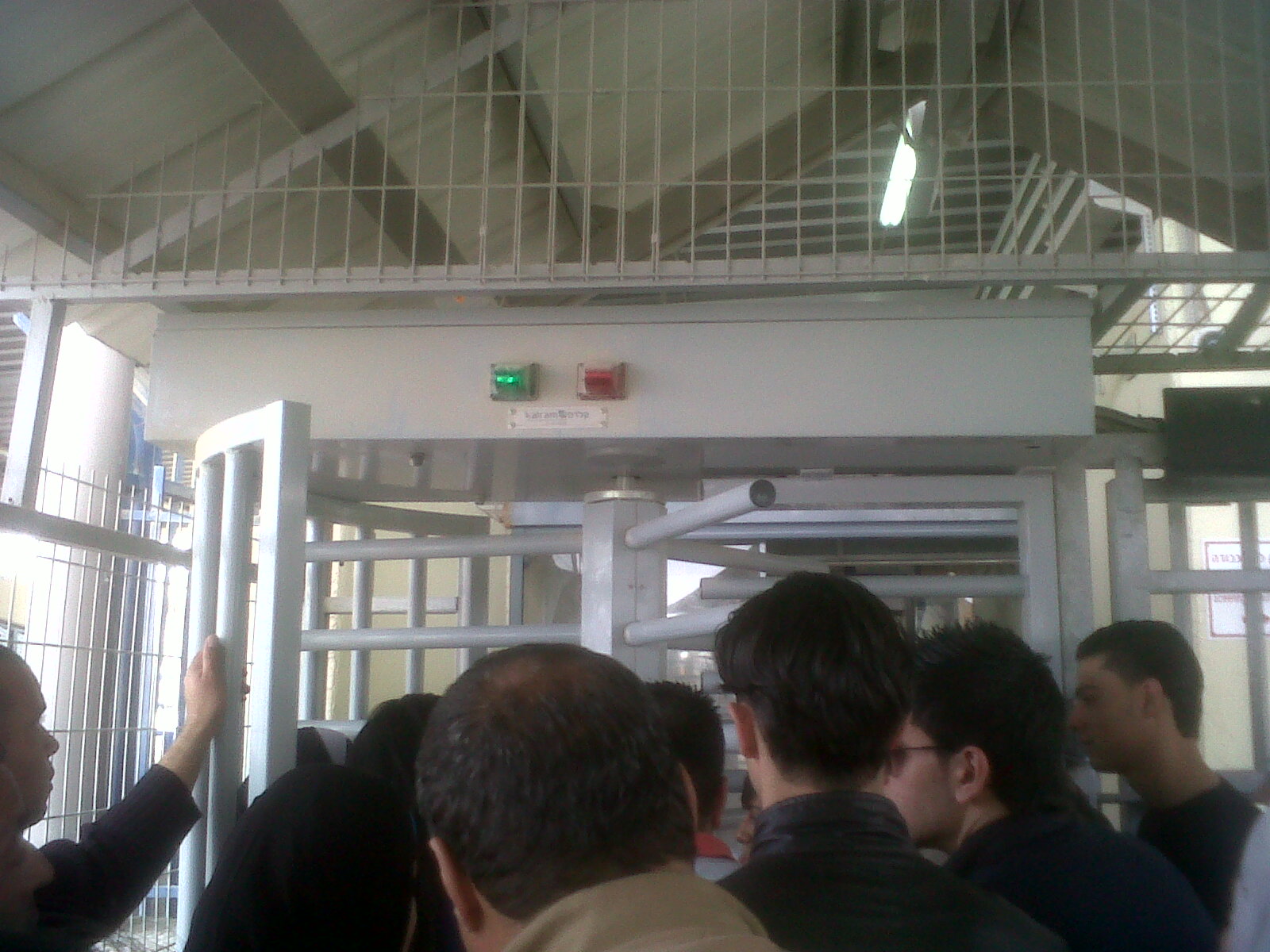
My eyes are fixated on the dusty green semi rectangular light that is not lit.  The metal turnstill has two people sandwiched inside, stuck.  Patience is running short and everyone waits, hoping that this small green light will light up, which will mean that the turnstill will turn, which means that 3 or 4 more people can go through the turnstill, put their belongings in the conveyor belt located about 5 feet from the turnstill and step in front of the soldiers behind the heavy glass window, to show their id.  Before getting to that point, tens of people are waiting in crowds inside this space, the best way to explain what this space looks like is to describe it as a metal caged corridor.  There is metal everywhere and you are stuck inside.  Waiting in front of the turnstill, waiting for that stupid light to turn green.  What’s taking so long? Why does the light turn green only once every 10 minutes and why does it let only 4 people through? Nothing, the soldiers are just taking their time, switching on the green light for a split second, and then chatting with their buddies or talking until they feel like switching it on again. Meanwhile, men, women, kids, elderly, Palestinians of all ages are standing in the metal corridor, waiting.

If you want to get to Jerusalem  (no longer the West Bank but Israel) from Ramallah (the West Bank), this is what needs to happen.  (Back in the day Ramallah used to be a suburbs of Jerusalem, and the distance between the two places is a mere 6 or 7 miles).   You catch the bus from Ramallah, you get to Qalandia checkpoint to get to Jerusalem.  As you near the checkpoint, traffic increases and cars and buses are lined up and people slowly start getting off from the buses.  The cars go to another line, where they are stopped one by one, the drivers need to get off, open the trunk and all doors so the entire car can be inspected. The passengers from the bus get off and they go inside the metal barred corridor, crowding and huddling together, standing in front of a turnstill.  When they are allowed to go through the turnstill, they put all their belongings on the conveyor belt, go walk through a metal detector, stand in front of the soldier to show their id, they are questioned, when the soldiers are done, they then take their belongings, then walk through another turnstill, exit the metal barred corridor and get on the bus again, wait for it to fill up, and then drive adjacent to the Apartheid Wall and continue the drive to Jerusalem, another 25 minutes away. 

The part from huddling together in front of the turnstill to getting through the turnstill takes the longest.  3 or 4 people max get through at one time, every 10 minutes.  At least a 40 minute to an hour wait, depending on how many people had been waiting before you including all the people that came down with you from your own bus.  Sometimes the soldiers don’t like how you walk in through the turnstill, so after that long wait, they might ask you to go back through the turnstill into the huddle of people, and came in again, to repeat the process. 

 I counted how many times the turnstill turned the last time the light turned green.  Once..twice…three times..and stuck on the fourth.  Sandwiched again are two more people. “Allahu Alam” one man says (God knows all), as he gets stuck in the turnstill.  I look at my watch.  It’s been 35 minutes we’ve been standing in this cage in front of the turnstill.  I peek in front of the crowd to see a woman in a purple hijab and a mauve jilbab, who had gone through the turnstill the last go, now separated from us (the rest of the huddled crowd behind the metal barred barrier) who repeatedly has to go through the metal detector because it keeps on beeping.   Someone from our side yells out, “maybe it’s your hair pin! Or maybe it’s a clip!”.  She turns around to look at our direction, with an annoyed look.  Finally she takes off her boots, and goes through.  “She wore THOSE boots? Didn’t she know she was going through a checkpoint??? The problem is in us! The problems are in us that we don’t understand” said one man watching the woman take off her shoes and go through the metal detector, finally without it beeping.  Impatience runs high.  People are waiting.  More people are spilling into this corridor from other buses, the huddled crowd gets larger.  When the turnstill turns again, people start bickering “your bus came AFTER mine sir, I go in first!”.  “Allahu akbar” someone else says.  People push and shove because they want to be next to get through the turnstill.  Another man says “I wish the tsunami would come and wash all of us away”. 

Now it’s been 40 minutes that we’ve been waiting.  The anxiety, impatience, irritability is palpable.  And I feel myself getting angrier and angrier.  The first 15 minutes had been fine as I chatted with people I knew, trying to ignore the metal bars.  But after a while it gets to you, and it becomes increasingly more difficult to control your thoughts. 

Last time I was here, in this situation, the soldier didn’t like how a group of us had come in through the turnstill.  He wanted us to go back, into the crowd.  “he wants us to go BACK?” I had asked my roommate, who was with me, in utter rage and shock.  We had been waiting for over 45 minutes.  The handful of people being given this order were all equally puzzled, including the elderly women carrying their bags of vegetables.  The soldier, without flinching, picked up his m16 and pointed it at us.  The gun pointed towards us to make us understand that he wants us to go back.  Standing in front of a soldier, with a gun, who points it towards a group of people, knowing that he is not regarding  any of the humans in front of him as legitimate  human beings, I observed my thoughts become angrier and angrier and turn violent.  Who did he think he was? How could he so easily point his gun at us? Does he know what he has in his hands? Why are his fingers on the trigger? It’s an automated gun!  Why don’t all the people, all the Palestinians just storm the checkpoint and beat this asshole up?  And point the gun in his face instead?

 All of us quietly had gone back into the massive crowd of people behind the turnstill, to wait once more.  My blood was boiling with rage, not being able to fathom how someone could use their gun, to point it at people without a flinch. 

A year ago when I had gone through Qalandia for the first time, I didn’t have to get off the bus.  I had remained on the bus and just had to flip my passport to the page with my face on it and the page with the Israeli stamp on it and that was it.  I remember thinking “this is not so bad.  It’s like a bad traffic jam, and you have to sit for a while, that’s it”.   The last time I had to get off the bus and I was with my roommate, she told me “just pretend you’re waiting in line at an amusement park, like Disney land or something”.  And I remember thinking, hmm yeah..it’s just like waiting in line.  Like bad traffic, like a queue for something, anything else, something else that is normal.

The absurdity of the existence of checkpoints didn’t hit me until I had to look at it repeatedly, from the windows of my bus, after coming back to Palestine from somewhere else (Jordan, Egypt, Bangladesh) and re-entering the situation, I would realize the abnormal and unnatural presence of this construction, the supremacist, revolting nature of this procedure that very few people in the world have to go through, where people’s worth are deleted, degraded and reduced.  Human worth is reduced down to an ID. What color ID, what kind of ID, and the expiration date of the ID.  You can pretend you are just in line for an amusement ride, you can pretend to sing songs to make the time pass, or chat about something else, or maybe peek at the encased video camera peering at everyone in the corridor, and just wait patiently, but the pointless  80/90/120 minute procedure to get from one city to another, having to face soldiers, an apartheid wall and going through security, to get to some place 6 miles down the road is outrageous to say the least. 
6 miles.  Boy is it going to feel weird to go home, back to the States, to travel from Chapel Hill, North Carolina to Fayetteville North Carolina, 90 miles apart in probably less time than the time it takes me to get through these 6 miles from Ramallah to Jerusalem. 

Saturday, February 26, 2011

An Undignified Day at the Dead Sea


The soft, silky, black clay squishes through your toes as you step into the Dead Sea.  There's no sand like there is in other beaches, it's just clay.  You have to be careful to make your steps as you get into the water because your feet sink into this clay, sometimes slippery and sometimes planted right in, molding into the clay.  Picking up a handful of this stuff, you feel like a kid, playful and excited to smear the black clay all over your body, which literally makes it look like you are smearing on a new layer of garment on your bare skin the clay is so dark.  The blacker the better.  Standing at the  lowest point on earth, I saw other people, east asian tourists, americans, rusisians and israelis at Kalia Beach, relaxed, enjoying a great time by the sea.


For me, it was one of the most undignified days of my life that I don't think I'll ever be able to erase from my mind.  I was trying to love what i was being told to love, "look you float! you can't drown even if you tried, you'd actually have to try to drown", "look how much fun this is!".  for someone who doesnt know how to swim and has full fledged panic attacks in water if my feet are not planted and not touching the ground (I'm sorry, im not a fish, it's the most unnatural thing to do for me, and I frankly feel like I'm going to die), the fun was ok.  No splashing, no putting your head in the water, and no swimming, were some of the rules, because it's the saltiest body of water on the planet, and it's the Dead Sea, nothing lives in it.  In one brief moment when I felt like i lost control of my legs, I thrashed some water and got some in my eye.  it burnt like hell, imagine pouring straight up salt water into the insides of your eyes.  So much for a beach.

The only fun thing is the mud. And it's fun wondering at the natural formation of it, the clay and the salt.  The fact that this particular beach is an Israeli ONLY beach (foreign passport holders also welcome), that Palestinians are prohibited from entering and that we were sitting there, in such an utterly disgracefully segregated, racist, supremacist place, had me feeling revolted and sick to my stomach.

The man who drove us on the orange van straight from ramallah, asked us at the crossroads "do you want to go to this beach or that beach".  kalia beach is one that one of us had been to before, so we opted for that one.  pulling into the parking lot, we saw two cars with Arabs be turned around.  the driver told us "hoon Arabs mamnuya, and there Arabs masmuh".  Arabs are prohibited here, the other beach down the road is where Arabs are permitted.

The fact that we willfully entered through its gates to deal with the rude service, and overpriced tickets and towel service, to sit in a place, watching all these human beings enjoy the beach and the water, where Palestinians are prohibited blew my mind away.  We work in palestine, we deal with palestinians, we love palestine like a home, but here we were at a place where palestinians are prohibited, because we wanted a beach fix, to sit under the sun, to look at water, to 'relax'.  i felt disgusted and felt little pieces of dignity be stripped away.  It felt like i had stepped back in time, pulling out a historical memory from my mind that I only imagine from books, where segregation looks like photocopied pages from history books with signs from the civil rights era : "Blacks Only" and "Whites Only".  And here I was in 2011, sitting at the beach where the "lower breed" of people are prohibited from entering. "Israelis Only"

we left in the morning, excited, to leave from Ramallah to go to Jericho.  Fridays are slow, the orange fords which stand congregated in an empty parking lot, had its drivers sitting and talking lazily, as they were looking for passengers.  buses/vans only leave when they fill up.  the jericho ford van driver gladly took us 3 foriegners and took off to Jericho, 3 passengers was probably the best he could do for a Friday.

more coming soon..

Basel

Bassel Ezz's father stands outside the door 5 or 6 minutes before the last bell is going to ring as I am still teaching.  He's mulling over his prayer bead being rolled around, each single bead at a time, between his fingers on his left hand.  Basel Ezz is suddenly insanely sharp and alert and during these last 5 or 6 minutes, after having seen his dad stand outside through the little square glass window on the classroom door, frantically writes down the ten sentences that he was supposed to copy down from the board.  The quiz had started as soon as the class started, 40 minutes before, and everyone else had finished, and were too busy, excited, packing up their things to go home.

The day before Basel Ezz had planted a punch in another kid's mouth in my class, and had given him a bloody mouth.  The recipient of this bloody mouth is a rather quiet boy, studious, and one that generally stays out of trouble.  I was livid to see this happen in my class 5 seconds into entering the room.  By this point I can't count how many times I've given impromptu lectures/classes on violence and have had discussion with my kids about why and how it's wrong.  I can't count how many ways and how many techniques I've tried with them to make them realize that it's something that Ms. Fahmida takes extremely seriously, and it doesn't matter if no body in the school cares about this, but if I find out that one of my student was beating up another kid, they are automatically at risk with their class grade.  they didn't take it seriously at all in the beginning.  some got it. after months of going at it with this, most now get it.  especially if they study for hours for their tests and automatically get 15 points taken off their major class tests at the cost of a fight.

As the fight was going on in my classroom, everyone else in the room was chanting and singing, egging on the fight.  Storming into the middle to drag out Basel Ezz and Yusuf, and furiously yelling to silence everyone, then picking out one kid and handing over the classroom marker and yelling in front of the class "if ANYBODY moves, talks, laughs, or makes ANY problem in this class while i'm gone, and your name is on the board, you are DONE!"  (what I meant by that even I don't know) and I told the kid to just write names if any body makes a single noise instead of doing their work.

Storming up into the office, I was frustrated wanting to show someone what had happened.  The social worker of the school didn't seem that moved, and instead asked me if I was free 7th period to talk.  And all I could think was, do you see this kid with the swollen face?  I need to get back to class, I don't have time for this.  Basel is not coming back into my classroom.

He gets into a fight every single day.  And everything is funny to him and everything is a game.  Last week I had 'suspended' him from my class after walking in on him beating another kid.  Suspension basically means sitting in the school office.  No one talks to him when he's sitting there, I can't talk to him when he's sitting there because I'm teaching, and when the bell rings, he goes right back to his next class to continue his games.  No one ever explains to him what he did wrong or how it was wrong and why he's being punished.  He's 10. He is capable of understanding why people are upset with him.  But he himself doesn't get upset until he sees his dad.

When I saw his dad stand outside the classroom door, my instant reaction was a sigh of exasperation.  It was heartbreaking because I knew how Basel would react.  He frantically was trying to finish his work, which he obviously cares very very little for.  After the bell rang, the father with an embarrassed smile asked me (without saying anything) what was the problem.  He looked at me with a quizzical face, hinting that I had to start the conversation.  "Your son gave another student a bloody mouth in my class yesterday and I am sorry he's not attending my class anymore.  I'm sorry but that is not something I will accept in my classroom"

Basel comes out embarrassed and scared and nervous, and his father starts lecturing him.  A couple of months ago, the father had sent a gift with Basel to give to me, and the only thing that I had thought to myself was wow... these parents are doing everything wrong..bribing is not going to help the situation.  Locking up your son in the closet is not going to help, and certainly beating the crap out of him at home is not going to help.

I knew that something was up with this kid, the first time I had startled him when he wasn't paying attention by going over to him to ask him to take out his books, and his instant reaction was to duck, taking cover under his arms, as if I was going to strike him.  It had thrown me off too..and I had told him, "Basel, just take out your books, I wasn't going to hurt you"

By the end of Basel's dad's lecture to Basel in front of me and the school social worker, basel was crying and shaking.

It's heartbreaking. I am just immensely frustrated for many many reasons.  Being in a situation, and teaching in a place with no structure, no discipline, no order and no consequences, sometimes i feel like i've ducked my head under quicksand and i'm struggling to get out. I feel like all the work and effort that I'm putting in trying to change the kid's behavior and attitude towards violence is undone and unraveled by other teachers who  hit kids, and by the lack of enforcement for any kind of consequences for kids who are being violent, both with their peers and with the teachers.

A kid like Basel needs to be pulled out for some time for an insane amount of one on one attention, something that I can't give.  He needs to be sat down and he needs a whole lot of love and encouragement, which is not something he gets at all.  He needs to talk out this violence thing, something that probably makes no sense to him or to his parents.  He needs to know that actions have consequences, something that is never enforced to him in a healthy way, both at home or at school.  In the heat of the moment during a 40 minute class block, I feel like I'm observing the situation and the scenario from several different lenses, but i'm handicapped unable to do anything at all with any of them.

Sunday, January 9, 2011

Israeli Newspaper


A picture of a Palestinian child crying as a result of losing family members in the atrocious 2008 Israeli attacks in Gaza is used as the face of "Desperate Hungry Israeli Children".  

A little twisted?  Where does this money go? 

Wednesday, December 8, 2010

Stop Shooting Children

I'm shocked that a congressman in America said this, and I feel that this is worth sharing.

"On this Human Rights Day, it's the least we can do."

Tuesday, November 30, 2010

Two Cracked Heads and a Terrible Tuesday

I saw Sleiman (4th grade), with his scrunched up eyebrows, pouted face and clenched fists, sitting in the main office chair with his feet dangling, looking at the ground, as 3 adults were screaming at his face.  The secretary of the school, an otherwise smiling, sweet, soft spoken woman, was scolding him with full force exasperated rage.  Two other teachers were also taking turns yelling at him.

Minutes before, as I was making last minute photocopies of some worksheets, I saw a crying child run into the same office accompanied by the Math teacher, who had a tissue pressed against the kid's face.  Not his face, his eye.  I recognized him, though I don't know his name. I knew he was Maher and Mohammad's (twins) younger brother, who was freaking out, because he had a busted head, and the injury was right above his eyebrow.  With the clamor of the teachers, the crying kid and the photocopy machine, I couldn't make out anything of the story, except that the name Sleiman Izz was being repeated over and over agian.  "damn, my sleiman?" I thought, realizing it was my 4th grader Sleiman who gets into trouble almost daily, almost in every class, and he's been 'kicked out' of the school several times now.

The last time I had taken him to the office was when he took out his pant strings and had playfully tied it around his friend's neck in my class, and by the time I realized what was happening the friend was choking, unable to breathe.  The kid behind him took out his small pair of scissors and tried to cut it off.  I'm not sure where this reaction and instinct came from, but within seconds I had stormed over to the other side of the room where they were. "BACK OFF!" and I had taken a pair of scissors to cut off the string from the child's neck so that he could breathe.

So here was Slieman again.  In the office.  Though I felt really terrible looking at him sit in the office with adults screaming down his face, I had absolutely no idea what to do.   He's been talked to by the school 'social worker', the principal, his mom, i've had discussions with him, with the principal, and his dad, he's been suspended, kicked out, punished, everything.  His answer is always the same when you ask "why did you do this?" "they hit me first!".  It's like he never understands the gravity of bad actions, or the fact that pushing someone is bad, punching someone is worse and busting open someone's head is really really reeallly bad.  for him, his reactions are all the same, and no matter how many times people explain things to him, he repeats the same things over and over again. during break, the other kid had done something (hurt Sleiman's fingers or something) and Sleiman threw a can at the kid's face.

Ten or fifteen minutes later, the secretary came back into the office and sat down next to him, to talk to him softly to ask what happened.  Sleiman burst into tears and by that time the bell had rung so I had to leave to go to my 7th straight class of teaching.

On my way, I saw the back of another kid's head.  Carolene's brother.  Carolene is a really really super slow student I have in 5th grade, who doesn't know much of anything,  (the only thing she knows how to say is "Hello teacher!" and "Goodbye teacher!' and had to repeat grades a couple of times now).  Her brother's head was bandaged up in the back, a spot the size of a fist, with gauze and bandage.  Yesterday, he had busted his head open after prancing around, hitting other people, and jumping around and falling and hitting something sharp, and then he was taken to the hospital.

Yesterday I had a skype chat session with some folks back in the States, it was my first time doing something like this.  I had mentioned that the kids here fight a lot and that the fighting is violent.  I had grazed over the topic, and was reminded after the session was over, by my best friend, that it's important to distinguish how the violence and the fighting that I see here is different.  Kids fight in the States too.  People don't really get a picture when you say "the kids are really bad".

This week is no different than any other week, things like this happen daily and weekly. it's just somehow this kind of exposure to school violence like this leaves me less and less shocked each time, until someone reminds me that it's worth mentioning and pointing out what it is that as a teacher I actually do see in school everyday.  and that it's not normal.

Sunday, November 28, 2010

Zamzam Water and Kisses

A lot of people ask me why I don't teach in America.  "If you love it so much, why not America? And if you really did want to teach, why travel so far away and leave home? Why here?"

Well let me tell you why. You know why? Because in America I wouldn't have students showing up to class excited to share a cup of Zamzam water ( http://en.wikipedia.org/wiki/Zamzam_Well ) with their teacher, that their grandparents brought back for them after completing the Hajj.  Nor would I have students who start class only after they give me a kiss on the cheek  Nor would I have students that I can be affectionate with. Showing them both kinds of parental affection: extreme kuchi koo cutness lovy dovy love to encourage them, and strict, reprimanding, scary, yelling, firm,discipline to straighten them up.

If I did that in America, I might have a lawsuit filed against me or I might be ousted from the teaching line all together.  For showing feelings.  Or not being a slave to bureaucratics.

I go through massive ups downs when I'm teaching.  It's not fun breaking up fights, or having to scream, or having to feel like you're baby sitting kids instead of teaching them.  27 kids, 40 minutes at a time, 5, or 6, or 7 times a day.  And it's not fun dealing with their tantrums or their sheer volume, which fires up your nerves into smoking, flaming, smithereens.  Or pulling them out from beneath chairs, desks or cupboards.  Or having to hear 10 of them speak to you in their loudest voices about 10 different things, completely unrelated to class.  Nor is it fun when they are angry at you, nor when you've lost your temper, for the umpteenth time during the day.  And it's really not fun grading stacks of papers and notebooks filled with incoherent, illegible scraps of writing that gives you a migraine just looking at it.  Nor is it fun having to correct every snippet of conversation kids have with you to correct their verb tenses, pronunciation, or vocabulary.

But certain moments, when you have a student who runs up to you in class, and they share something with you that is extra special to them and you see them act in the most humbling, selfless way, opening up their hearts to you completely, which then makes you realize how lucky, and blessed you are as a teacher to experience raw, pure, selfless love that most people in the world probably don't know how to experience, you understand why it was that you chose this path in the first place. They live on the tip of their innocence, volatile and sensitive, yet forgiving and compassionate. It makes you realize how much you can learn from your students, instead of the other way around.

Thursday, November 25, 2010

Shaheed

november 7th, 2010
“why do people have to shoot people in the mouth? like why not somewhere else? why in the mouth” i asked my roommate exasperated, frustrated and disgustingly bewildered.  “well what happens is when you do that you make sure...” she caught the look on my face and paused to switch gears to ask “ wait was that a rhetorical question or did you actually want to know?”  i didnt actually want to know, i was just not dealing with it, it being what i had heard a mere hour before on a car ride back home. i figured, ah what the heck “yeah ok tell me”
“what happens is, you blow out the back part right here, which controls your breathing and functioning, so you make sure that the person is dead, like if you shoot someone in the brain you know you could fuck them up, you could kill them but you could also have a chance where they dont die theyre just fucked up in the brain, but putting a gun in your mouth, you are dead”

ghassan’s uncle's blown out brain was splattered on the staircase after the IDF had stuck a gun in his mouth.

I was and am still frozen.  I feel like i can’t function? why? i’m not sure.  ‘im not thinking.  im just frozen.  the only thing i’m thinking is, ok maybe it makes sense to document what i’m feeling right now, this doesnt feel right, this feels unnatural, is this real? this actually happened to them.  this actually happened to them.

i feel slightly immobile.  maybe it was ghassan’s mom’s stoic face, her sweet and calm voice as she was telling me this horrendous story as we were driving back in the car, and the warmth of this family and the jovial childishness of his grandfather that makes this unbearable. maybe it was their gracious welcome into thier family farm, their family house, and into their village, and the delicious family dinner, and sleeping on the floor with the kids sprawled all over me after an exhausting day, that makes me feel this way.  my heart is heavy and restless.  

Its restless because conflict, war, weapons, death, violence, guns, soliders, settlements, suicide bombing, murders, checkpoints, restrictions, and resistence, these are not concepts to me anymore, and anyone who has not experienced these in their own reality, only deals with these notions as concepts, not a reality. when it permeates into your sense of self, life perspective and your external world, and when it affects people you know, and even worse care about, these concepts turn into an ugly reality that you wish never existed.  
the juxtaposition of ghassan’s 8 year old free and strong spirit running around side by side with his grandfater in his village, and the shaheed pictures and portraits of his uncle hanging on the walls of practically every room was another testament to something that I feel like I've felt too many times in Palestine: witnessing the pureness and the innocence of humanity side by side, simultaneously, with the pure evil and worst of humanity.  
we were on our way home from Kufur Thalth to Ramallah and we passed a graveyard. Ghassan's mom wanted to stop for a little bit and asked all her kids to pray and recite Surah Fatiha in their duas. She told me that her brother was buried there and every time they pass by the graveyard they pay their respects. The only thing I knew about this brother was what she told me every time she mentioned him "my brother. the Israeli people killed him". 

I knew that he was in prison for 5 years, for being too 'outspoken' in college. "He was really shy and quiet. But he spoke up against a lot of things". and they would take him to jail, for indefinite amounts of time, and then let him go and come back after him again and again. I asked Ghassan's mom "wait why do they take people to prison?" it was a rhetorical question. with my time here so far and talking to people, i know that there are no good reasons why people are taken to prison. if the Israeli soldiers feel like putting you into prison, they'll put you in prison.  
He was only 20 years old, with a really artistic spirit. Through his 5 years in jail, he made art in prison. The living rooms which carried the portraits on the walls, also had his artwork placed on all the shelves. like incredible art. he took cardboard he found around prison and made replicas of the Dome of the Rock, and built sculptors and frames, out of things here and there. 

Artwork : made entirely of cardboard and thread
I couldn't believe this man had made all this in prison. He also taught himself Hebrew during his time and the last time he was in prison and then taken to court he demanded that he would defend himself. There was no evidence, or any reason for him to be locked up, and the judge let him go. After they let him go, he changed his identity. He moved to Nablus, changed his name, changed his looks, and started a new life and had disconnected himself from his family. They had no idea where he was for three years. He just did not want to go back to prison. So one day, jeeps showed up outside the family's house where he was staying, and they called him by his real name, announcing that they knew where he was and that they wanted him. The building was evacuated. He hid on the roof of the bathroom. When they raided the building, they found him, and at the staircase, they put a gun to is mouth and blew out his brain.
The mom found out watching the news, her son's face on the screen, who was now dead who she hadn't heard from in 3 years. She went crazy.
I kept on thinking about the locket that hangs around her neck, with her son's picture, framed in gold, that I noticed everytime she came over to sit next to me or talk to me.
Ghassan's mom at that time was in Gaza, and she couldn't get out. She heard about her brother, from her husband who heard from another family friend. She was only able to visit the grave, after their house was blown up in Gaza in 2008, they were able to get out, and start a new life in Ramallah and move to the West Bank under special sanctions.
When the dead body was given to the family in Nablus, the family took the body and wanted to bring it to the village Kufur Thalth to bury it there. At they checkpoint, the soldiers stopped the mourning family and told them that they could go, but the dead body could not go. Because the dead body is obviously a threat.
After hassles and chaos, the other brothers carried the corpse into the village.
Several months later, the soldiers showed up at their house again. This time wanting to take the other brothers into prison. "One is already under the ground. We have to show you people what you are playing with" This is how they would come to the house and interrogate the brothers, the ones that are alive.
I'm listening to this story, and my entire perception of my weekend changes. I am in utter shock hearing what I"m hearing and I'm replaying over and over again every single family member that I had met, and trying to imagine what they had to go through. A village turns into a battleground. And an innocent weekend turns into something else, I can't even explain.
I failed to realize how heavily their story impacted me until I realized that I was sort of shutting down, because there are some things and some feelings you just can't explain. And it's a slow process. Sometimes you go through feelings and you feel like you are in a mind warp where things just don't make sense. Or you feel anger when you realize how blind and deaf the world chooses to be.
I was telling my best friend that, I KNOW this happens, I KNOW what a Shaheed means, I know this happens in Palestine, I KNOW this place is under occupation. But then after experiences like this, I realize I don't know anything at all. It's different when it's real and not just a story. The reality becomes so shocking sometimes that you perceive it as a stranger and you feel foreign to it.

Friday, November 19, 2010

Sheep Milk and Duck Brain

I had never drank sheep milk before.  But there it was, a hot steaming cup of sheep milk, which came straight out of the sheep that morning.  Who could say no to that?(perhaps a lot of people) I took the cup eagerly from Ghassan's mom's hands only because I was curious about sheep's milk, and the strange bitter aftertaste wasn't that big of a big deal after two scoops of sugar.  The fact that the hot steaming milk soothed my cramps, also left me quite happy.

The night before, I had arrived to Kufur Thulth, a small village outside of Qalqilia.
 Ghassan is a kid that really does have a special place in my heart.  I had heard a snippet of his story from my former roommate, who briefly had told me about this kid, Ghassan, whose house was blown to shreds in Gaza, who had gone to the States for 40 days, coincidentally taking the same flight to JFK as my roommate was.  Having the same layover in NYC, my roommate took the opportunity to show Ghassan and his two younger siblings the magic and hype and madness of new york city in December, and the kids jumped at it, being crazier than the city itself, experiencing something they had never known before.  The mom frightened out of her wits let her kids do whatever they wanted to, because she was grateful that her kids were alive to be running around.

For the past two or three weeks Ghassan would come up to me at least three times at the beginning of class and perhaps five at the end of class to ask "Teacher can you please come to our village on Saturday?".  Each day it would be the same twinkling face with captivating kiddish gleam and the end of each class period was a pinch of dissapointment for him when I would mutter "I don't know Ghassan.."  It would give him more motivation  to be even more persistent the next day.

I had given up on the hope of olive picking because plans continuously fell through.  And as much as I did want to visit Ghassan's village (and knew that there were olive picking opportunities there) I didn't actually think it was going to happen for some reason.
But one Saturday afternoon after school towards 5pm I was stuffed in their car for the hour long journey, passing through the beautifully hilly terrain of Palestine, passing through the not so beautiful checkpoint a new one that i had never used before and towards the fall of darkness we had squeezed inside a cramped garage after cautiously driving through a wobbly narrow village road.

Baby Danny, Dana, Yazan and Ghassan, myself and Ghassan's mom spilled inside the house and I met their jovial, playful grandfater, who was a thin, short statured man with more energy than the kids, running around (literally in circles) playing with his other 2 year old grandson.  But his body boasted years of labor.  You could tell he works in the fields, a lot.  What I loved more about him, more than his youthful energy, more than his laughter, were all of his facial lines, and his face was absolutely filled with lines! And his smile would have an accordian player effect on his face.   Ghassan's grandmoter was much quieter, and she didn't speak much, she just greeted me with a very warm smile, and called me to dinner which was a giant feast of Makhluba with sides of pickles and olives (like all dishes here) and though I didn't understand the family conversations, it was quite special to be eating a meal with Ghassan, who seemed to be in disbelief that I was there, his mom, his sister, his brother, his grandfater, grandmother, two uncles, one aunt and two more cousins.

Ghassan and Yazan took me outside to see all the birds they have, all the cactus plants they have, all the flowers they have outside, their lemon tree, fig tree, almond tree, banana tree and god knows what else.  "There are more in the Mashtal teacher!".  I didn't know what a Mashtal was but figured it was a place with a lot of plants.  "We also have sheeps and goats! I will take you there tomorrow! you can milk one if you want!"  he quite literally wanted to show me everything and his curiousity and energy was incredible.

What was also incredible was how hard, how absolutely hard, I was trying to ignore all the shaheed pictures of his eldest uncle, whose face was plastered in almost room with three or four portratis of him in each room, beside an ayah of the Quaran, with a green piece of cloth hanging out of the side of the frame.   One picture was of him with a gun in each hand (have you seen Paradise Now? remember the thing they do in front of a white tapestry with the guns in their hands as a testimony to what they are about to do? that's what the picture reminded me of) and I was ignoring it, all of the pictures, this house that was a living commemoration and a museum of a brutal death,  with all my efforts because I just did not want to know the story behind the portraits.

The next morning, we got up.  I had gone to sleep after playing with Yazan and Dana (Ghassan had gone out to sleep under the stars in the farm next to the sheep, and he had invited me to go with him, but his mom thought it was rather inappropriate for the teacher to sleep next to the sheep.  if it wasn't so cold I probably would have). Dana is this overly stubborn and spoiled 5 year old little girl who cries nearly every 10 minutes, sad or angry about something she didnt get.  and for some reason she has a fascination with my eyeliner.  so she climbs on me, comfortably sits on my lap facing my face, and starts playing with my eyes and my face.  Yazan is always fighting for attention because his older brother, Ghassan, has all the stories, and he wants a chance to be funny as well.  Both Dana and Yazan fell asleep on our floored bedding (prepared by their grandmother) on either side of me, with their legs strewn about on my back as I was sleeping on my stomach. I was too tired, maybe they were just playing on me and fell asleep tierd.

The next morning is when I had the sheep's milk.  The night before I had duck meat and Ghassan had asked if I like duck brain.  I didn't want to make a face so I simply said "no..never tried it before" and he took the cooked head of the duck and broke off the bones and ate the inside of the brains and chewed on the bones.  Finger lickin scrumptiousliciously good.
 He had been talking about the Mashtal, which I discovered was a piece of land with all kinds of plants that the grandfather tends to, and a place that Ghassan knows all about because he helps his grandfather and works side by side, or just runs around playing with his brother in the plant farm.  Ghassan was telling me how some of the plants are bred and how long they have been around and every fact he knew about them. He showed me tall cactus plants, he showed me where they kept the chickens and the rooster, and the parrots, and all sorts of other things.
We hung around there for a while and then went to their main farm, stretches of olive trees and a shed under which several flocks of sheep were just chillin.   When I was a kid, I remember going to the zoo with my third class and trying to feed a goat.  And then getting attacked by a flock of goats.  So a flock of animals, which resemble goats (the only criteria for resemblance : four legged creature with white hair/wool/outer coating, eyes and sometimes a horn) ompleteley freaks me out.
So going inside i kept on thinking 'o buddy..look at that..haha...ha..ha " It reeked and stepping inside you knew that you were stepping on top of fresh or old natural sheep shit fertlizer. And there was Ghassan storming through the crowd of sheep as if it all belonged to him, as if this giant flock of sheep should fear this little 8 year old boy. He would grab them by the ear and tug them around and put them in the right place in the shed.  there were rules about where each one should stay, and in our excitement we had messed up the groups.  one wrong move, and about 20 sheep stormed the small gate separating them from another part of the shed and mad rushed the entire shed.  I was frozen.  I dont like sheep running around me I realized (goat phobia kicking in).
We got out, and Ghassan and his grandfather saved the day.  His grandfather was at the Mashtal and he immediately left and rushed over to the farm in his white little car and muttered and groaned and yelled at Ghassan and in 20 minutes fixed up the shed and told us that the reason why the sheep are separated is because different types are given different foods.  So them mixing was a big deal because eating the wrong food would really make some of the sheep really sick.

The day ended with my walk with Ghassan's mom.  She showed me the olive trees.  Stretches of olive trees.  We walked for a long time till we got to the edge of the hill, and from there, in clear view was  a settlement.  Ghassan's mom and I had been talking for a long time, about their family, about the farm, about the kids, about the weird type ant that lives under the dirt that comes up and swallows this fruit seed in about a quick hungry second if you put it on the already dug out hole that the ant creates for itself (to catch the seed I guess),  and about cactus fruit that I had never tasted before.  She casually looked at the settlement (which for me is always horrific, looking at settlements absolutely drives me nuts) and told me that the family had wanted to build a shed on their farm so that her dad could rest after working in the land, but building anything on THEIR land would become a bomb target.  She casually muttered "the Israeli people would blow it up, we can not build anything"

On the ride back home to Ramallah, she told me about her brother.
-------------------------------------------------------------------------------

what is a settlement?
 they are  forced illegal communities built by the Israeli government in which citizens are paid to live, armed with state funded weapons on top of wiped out palestinian villages and communities.  palestinian hills have had to be destroyed, families have been ousted, homes demolished to build these communities.  residents of these settlments, known as settlers, are more often then not imported immigrants and more often than not staunch zionists.  cases of settler violence are frequent (examples include settlers shooting at palestinian communities that they overlook, burning or uprooting olive trees as a form of instigation or destroying palestinian heritage, restricting transportation and basic utilities) palestinians have separate roads that they must travel on, which goes around settler roads, which makes traveling around extra difficult and more time consuming.  palestinian communities often face a shortage of water, due to settlement communities.
this definition is not as articulate as it could be, but i hope you get the point.  settlements are illegal and they suck.